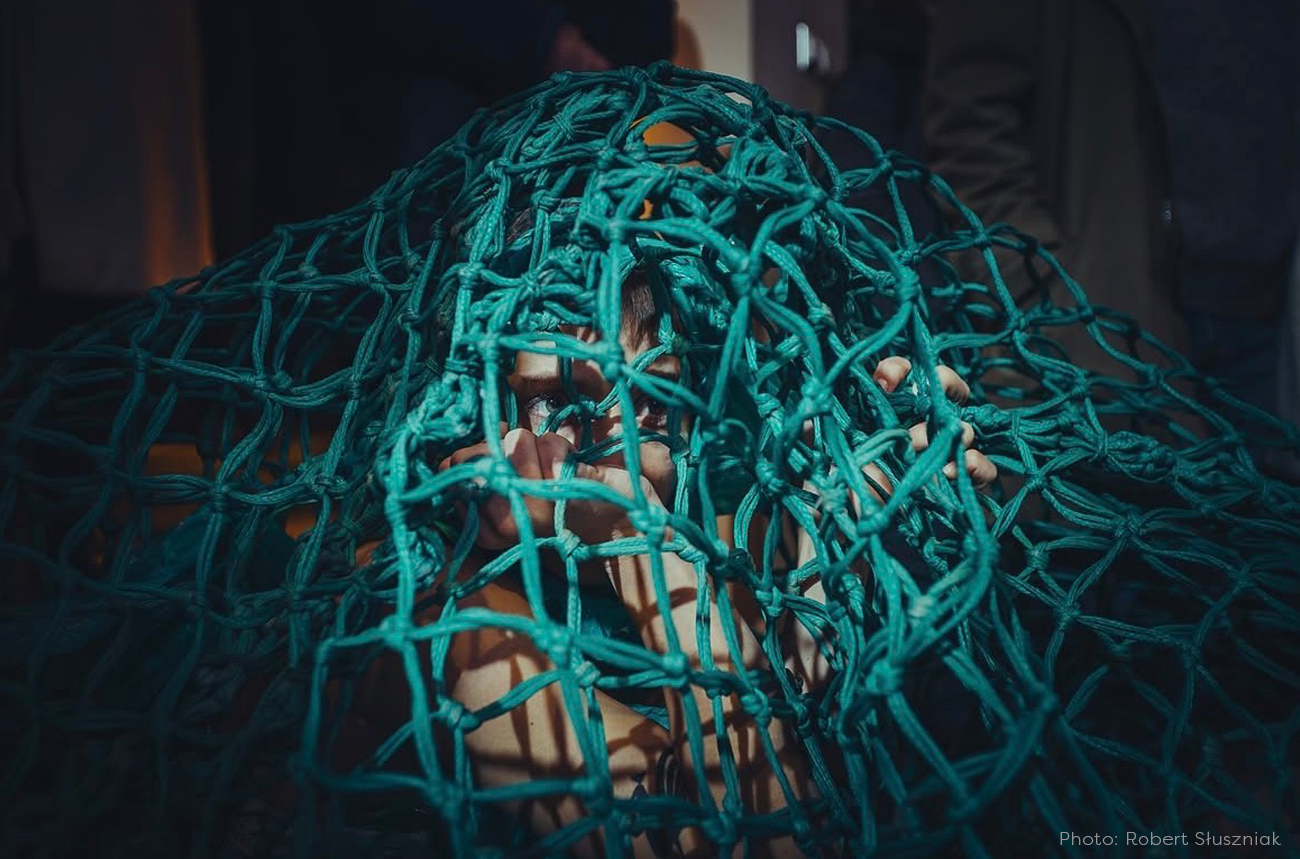
Action performed during the opening of the Open Eyes Art Festival in Kraków.
„Matnia” opened a series of performance works within the event Rozziew,
which was part of the Open Art 2024 exhibition. Curatoress: Ada Markowska
Sitting motionless for 1.5 hour under the weight of a several-meter-long
fishing net, the figure was perceived by visitors as an exhibition object.
Only after the official speeches had ended did the object “come to life”
in the corridor of the building. A slow, mournful walk of the still unidentified
figure began; entangled in heavy nets, it started to move through the spaces
of the building. Gradually, the audience could hear an increasingly distinct
sound of a murmuring river, as well as the voice of the performer emerging
from the moving “trap.”
At first, both movement and verbal expression were a significant challenge
within the large crowd. In subsequent phases of the performance, the voice
intensified, taking the form of a violent, confrontational, sung manifesto,
set against the growing sound of turbulent water. The lyrics of the song referred
to the relationship between the body, water, and the consequences of human
activity, treating the body as a subject entangled in environmental processes.
By involving the audience in the action – participants held boards with letters
that together formed a specific phrase – I posed the question of whether hydrofeminism
functions today merely as an aesthetic metaphor or rather as a real practice
of care for water and the environment, understood as responsibility and action,
as discussed, among others, by Astrida Neimanis in Bodies of Water.
In the final phase, the action is completely overwhelmed by sound recordings
of a rushing flood river. The figure sheds the nets and becomes motionless.
In their hand, they hold a small object with a QR code. Once scanned,
it directed the viewer to a fundraising campaign supporting animals from a shelter
in Lower Silesia that was affected by flooding.
„Matnia” opened a series of performance works within the event Rozziew,
which was part of the Open Art 2024 exhibition. Curatoress: Ada Markowska
Sitting motionless for 1.5 hour under the weight of a several-meter-long
fishing net, the figure was perceived by visitors as an exhibition object.
Only after the official speeches had ended did the object “come to life”
in the corridor of the building. A slow, mournful walk of the still unidentified
figure began; entangled in heavy nets, it started to move through the spaces
of the building. Gradually, the audience could hear an increasingly distinct
sound of a murmuring river, as well as the voice of the performer emerging
from the moving “trap.”
At first, both movement and verbal expression were a significant challenge
within the large crowd. In subsequent phases of the performance, the voice
intensified, taking the form of a violent, confrontational, sung manifesto,
set against the growing sound of turbulent water. The lyrics of the song referred
to the relationship between the body, water, and the consequences of human
activity, treating the body as a subject entangled in environmental processes.
By involving the audience in the action – participants held boards with letters
that together formed a specific phrase – I posed the question of whether hydrofeminism
functions today merely as an aesthetic metaphor or rather as a real practice
of care for water and the environment, understood as responsibility and action,
as discussed, among others, by Astrida Neimanis in Bodies of Water.
In the final phase, the action is completely overwhelmed by sound recordings
of a rushing flood river. The figure sheds the nets and becomes motionless.
In their hand, they hold a small object with a QR code. Once scanned,
it directed the viewer to a fundraising campaign supporting animals from a shelter
in Lower Silesia that was affected by flooding.