In my practice, I feel close to the idea of the Transformative Avant-Garde
proposed by Krzysztof Wodiczko, according to which art and design
can act more intensively in support of systemic change, going beyond
a symbolic gesture. Design thinking enables an interdisciplinary approach
to artivist practices—those at the intersection of art, activism, and social
practices. Its ethical foundation lies in empathy and responsibility, and what
follows from this is the belief that one should not be afraid of helping and of
taking co-responsibility for what happens in the social sphere. What we create
and initiate has the real power to shape relationships, attitudes, and imaginaries
of a better world.
In this context, the idea emerged to realize the action
Freedom. Equality. Intifada!, which marked the culmination
of my participation in the months-long project Laboratorium Percepcji
(Laboratory of Perception), carried out at the Grotowski Institute
in Wrocław. It was a 24-hour performance of solidarity with Palestine,
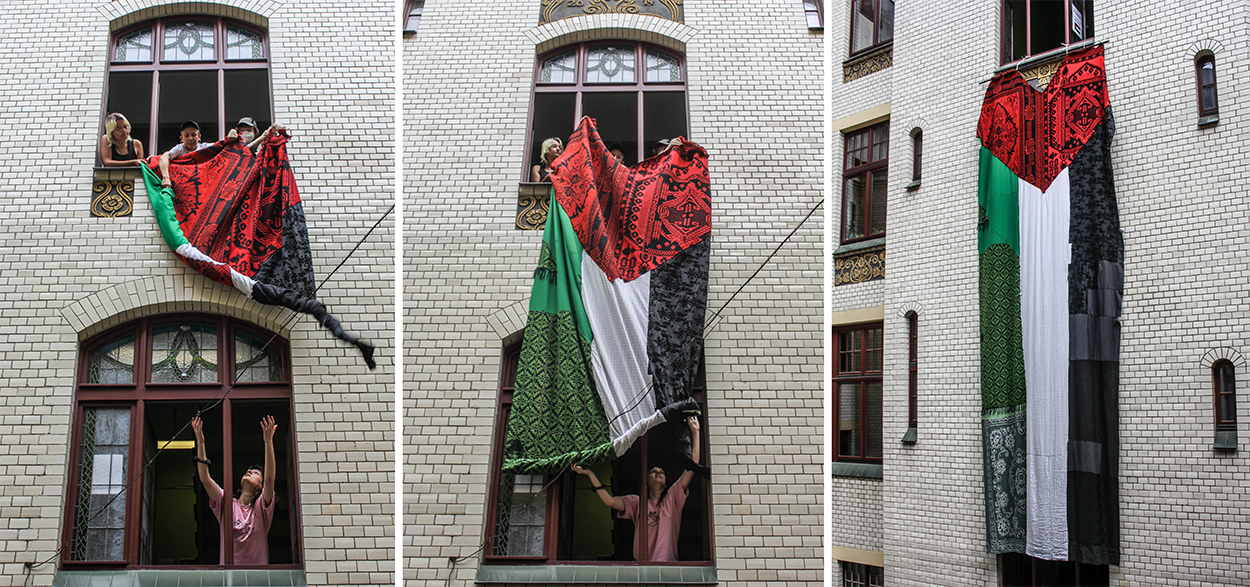
during which a huge flag was stitched together from pieces of fabric.
The daytime part of the action (10:00–20:00) was participatory.
Anyone who wished to express solidarity could join the collective sewing.
The action took place in silence. Through shared, repetitive work, we aimed to
create a space of collective presence and reflection. During the performance,
it was also possible to provide real financial support to the Polish–Palestinian
Kaktus Initiative via a QR code available on site. The nighttime part of
the performance was visible through the glass wall of the Bulvary building,
which made it possible for passersby to observe my work on the flag.
The long-duration character of the action was intended to draw attention
to the ongoing violence experienced by Palestinians –
violence that much of the world witnesses daily through social media,
often from a position of distance, safety, and comfort.
The concept of Intifada is key in this action. Many Arabic words
are misinterpreted or deliberately distorted in Western discourse,
stripped of their cultural and historical context. Social media and dominant
narratives often assess them exclusively from a Western perspective,
reinforcing fear-based and racist stereotypes. This mechanism of
linguistic manipulation is particularly troubling to me, because it leads
to the demonization and dehumanization of Muslim and Arab people,
even when they are victims of extreme violence. This is why the term
Intifada – which for some may sound radical—was consciously chosen
as the title of the action: to draw attention to the urgent need for
a radical shift in Western ways of thinking, using language, and building
solidarity with Palestine. Through this action, it mattered to me
to clearly express opposition to linguistic manipulation, discrimination,
and the silencing of voices that oppose the demonization of Muslim communities.
Ultimately, in Arabic the term intifada means any form of struggle
for justice and resistance against oppression.
The completed flag, measuring over eight meters, was hung
on 7th July at Szewska Street 50/51, at the Faculty of Cultural Studies,
during the peaceful student occupation of the University of Wrocław.
One week later, during a protest against the genocide in Gaza held in Wrocław’s
main square, the collectively sewn flag began to “take on a life of its own.”
Carried into public space by protesters, it was visible from above due to its scale;
drone footage was broadcast by Al Jazeera, reaching Palestinian
communities as well as people who read it as a sign of support coming from
activist circles in Wrocław.
In the following weeks, the action continued independently of my
direct involvement. Students initiated the creation of another
large-scale flag, hung on a different building belonging to
the University of Wrocław. Using the materials I left behind,
they also organized workshops for Wrocław residents, during which
participants sewed their own smaller flags – objects that could later
function in public space, for example during subsequent
solidarity demonstrations. I think I can say that, in the case of
the action Intifada!, it was possible to transform
the performative gesture into a shared practice –
one that could be carried forward and passed on.
I believe that opening up to thinking about performance art
as a tool for introducing real social change makes it possible
to act more intensively in support of systemic change, going beyond
a one-time manifesto. I even find myself wishing that art would
more often become a pretext for stepping out of one’s comfort zone –
and, in doing so, for moving beyond the safe walls of galleries
and cultural institutions. In this way, the attempt to design
social change ceases to be merely a performative manifesto
and becomes an action aimed at shifting perception.
Through the use of symbol, gesture, and process – elements
that move emotions and build narrative – design operates here
as a tool for creating clear, at times radical, social messages.
Crossing the boundaries of purely aesthetic art in favor of practices
with real social impact opens space for dialogue,
collaboration, and long-term change.
proposed by Krzysztof Wodiczko, according to which art and design
can act more intensively in support of systemic change, going beyond
a symbolic gesture. Design thinking enables an interdisciplinary approach
to artivist practices—those at the intersection of art, activism, and social
practices. Its ethical foundation lies in empathy and responsibility, and what
follows from this is the belief that one should not be afraid of helping and of
taking co-responsibility for what happens in the social sphere. What we create
and initiate has the real power to shape relationships, attitudes, and imaginaries
of a better world.
In this context, the idea emerged to realize the action
Freedom. Equality. Intifada!, which marked the culmination
of my participation in the months-long project Laboratorium Percepcji
(Laboratory of Perception), carried out at the Grotowski Institute
in Wrocław. It was a 24-hour performance of solidarity with Palestine,
during which a huge flag was stitched together from pieces of fabric.
The daytime part of the action (10:00–20:00) was participatory.
Anyone who wished to express solidarity could join the collective sewing.
The action took place in silence. Through shared, repetitive work, we aimed to
create a space of collective presence and reflection. During the performance,
it was also possible to provide real financial support to the Polish–Palestinian
Kaktus Initiative via a QR code available on site. The nighttime part of
the performance was visible through the glass wall of the Bulvary building,
which made it possible for passersby to observe my work on the flag.
The long-duration character of the action was intended to draw attention
to the ongoing violence experienced by Palestinians –
violence that much of the world witnesses daily through social media,
often from a position of distance, safety, and comfort.
The concept of Intifada is key in this action. Many Arabic words
are misinterpreted or deliberately distorted in Western discourse,
stripped of their cultural and historical context. Social media and dominant
narratives often assess them exclusively from a Western perspective,
reinforcing fear-based and racist stereotypes. This mechanism of
linguistic manipulation is particularly troubling to me, because it leads
to the demonization and dehumanization of Muslim and Arab people,
even when they are victims of extreme violence. This is why the term
Intifada – which for some may sound radical—was consciously chosen
as the title of the action: to draw attention to the urgent need for
a radical shift in Western ways of thinking, using language, and building
solidarity with Palestine. Through this action, it mattered to me
to clearly express opposition to linguistic manipulation, discrimination,
and the silencing of voices that oppose the demonization of Muslim communities.
Ultimately, in Arabic the term intifada means any form of struggle
for justice and resistance against oppression.
The completed flag, measuring over eight meters, was hung
on 7th July at Szewska Street 50/51, at the Faculty of Cultural Studies,
during the peaceful student occupation of the University of Wrocław.
One week later, during a protest against the genocide in Gaza held in Wrocław’s
main square, the collectively sewn flag began to “take on a life of its own.”
Carried into public space by protesters, it was visible from above due to its scale;
drone footage was broadcast by Al Jazeera, reaching Palestinian
communities as well as people who read it as a sign of support coming from
activist circles in Wrocław.
In the following weeks, the action continued independently of my
direct involvement. Students initiated the creation of another
large-scale flag, hung on a different building belonging to
the University of Wrocław. Using the materials I left behind,
they also organized workshops for Wrocław residents, during which
participants sewed their own smaller flags – objects that could later
function in public space, for example during subsequent
solidarity demonstrations. I think I can say that, in the case of
the action Intifada!, it was possible to transform
the performative gesture into a shared practice –
one that could be carried forward and passed on.
I believe that opening up to thinking about performance art
as a tool for introducing real social change makes it possible
to act more intensively in support of systemic change, going beyond
a one-time manifesto. I even find myself wishing that art would
more often become a pretext for stepping out of one’s comfort zone –
and, in doing so, for moving beyond the safe walls of galleries
and cultural institutions. In this way, the attempt to design
social change ceases to be merely a performative manifesto
and becomes an action aimed at shifting perception.
Through the use of symbol, gesture, and process – elements
that move emotions and build narrative – design operates here
as a tool for creating clear, at times radical, social messages.
Crossing the boundaries of purely aesthetic art in favor of practices
with real social impact opens space for dialogue,
collaboration, and long-term change.