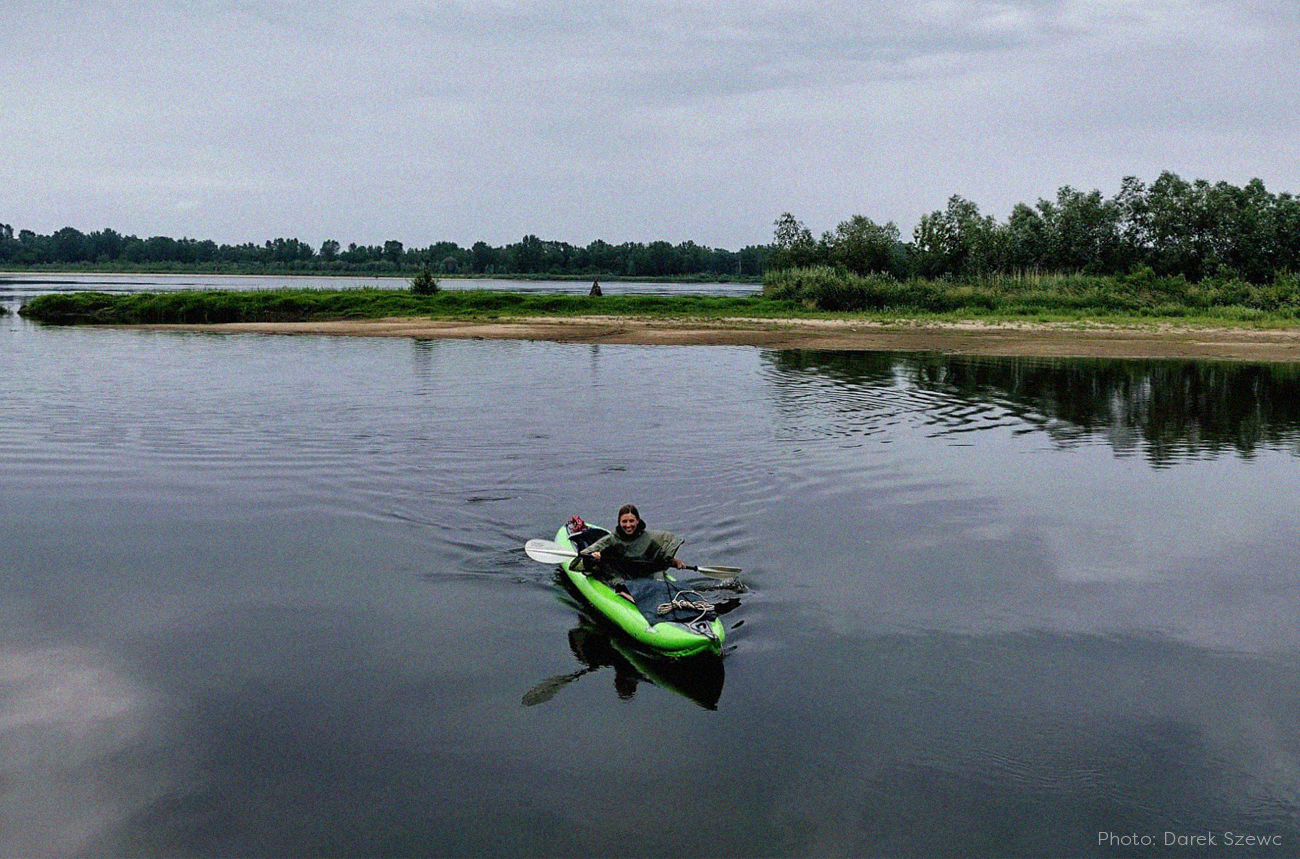
Protest-performance during which I kayaked over 1,000 kilometers along the Vistula River, from the Goczałkowice Reservoir in Silesia to the Baltic Sea. This artivist action was a form of protest against the destruction and artificial regulation of rivers in Poland. It aimed to draw public attention to the current situation of the queen of Polish rivers, which faces the looming threat of being turned into the E40 waterway for barges. This month-long protest-performance was a solitary journey — I received no institutional support and paddled the Vistula alone.
What proved most meaningful in this action were the encounters with people of the river:
traditional boatbuilders constructing wooden vessels adapted to the Vistula, and Flisacy
(river rafters), who taught me how to read the water, recognize currents, and navigate
the river — for no one knows the queen of Polish rivers as intimately as they do. I also met scientists researching life in the Vistula and ornithologists monitoring bird habitats and migration routes; presenting the perspectives of those who cannot imagine life away from the river offered an alternative to audiences who know the Vistula only as an urban, canalized waterway.
traditional boatbuilders constructing wooden vessels adapted to the Vistula, and Flisacy
(river rafters), who taught me how to read the water, recognize currents, and navigate
the river — for no one knows the queen of Polish rivers as intimately as they do. I also met scientists researching life in the Vistula and ornithologists monitoring bird habitats and migration routes; presenting the perspectives of those who cannot imagine life away from the river offered an alternative to audiences who know the Vistula only as an urban, canalized waterway.
Through this action, I sought to view the environment from the river’s perspective, to get to know its nature, and to turn the audience’s gaze toward the Vistula. I wanted people to see it not just from the perspective
of an urban, canalized waterway, but as a wild, majestic, living entity—one that is a unique treasure
on a European scale. While the rest of the world is focused on renaturalizing rivers and dismantling harmful dams, Poland continues to plan new projects that will have devastating consequences for the Vistula, aiming to transform it into a water “highway.”
of an urban, canalized waterway, but as a wild, majestic, living entity—one that is a unique treasure
on a European scale. While the rest of the world is focused on renaturalizing rivers and dismantling harmful dams, Poland continues to plan new projects that will have devastating consequences for the Vistula, aiming to transform it into a water “highway.”
In the era of accelerating climate change, we should be especially protective of freshwater.
If we run out of it, we won’t last long on this Earth. Rivers, these earthly “veins,” have painfully
experienced humanity’s extremely anthropocentric approach. They are constantly dammed,
dug up, straightened, and polluted. Yet rivers are living beings and deserve to be free. People should
respect them and feel a sense of reverence. Without water, there is no life.
If we run out of it, we won’t last long on this Earth. Rivers, these earthly “veins,” have painfully
experienced humanity’s extremely anthropocentric approach. They are constantly dammed,
dug up, straightened, and polluted. Yet rivers are living beings and deserve to be free. People should
respect them and feel a sense of reverence. Without water, there is no life.
Between 2007 and 2015, Poland destroyed almost 20,000 kilometers of rivers through so-called revitalization projects. In 2018, during the repair of the Włocławek dam, the flow of the Vistula was completely halted, resulting in an ecological disaster that killed over 5.5 million fish. In 2022,
the second largest river in Poland—the Oder—was brought to the brink of death.
the second largest river in Poland—the Oder—was brought to the brink of death.
Once you set out onto such vast waters, they change your life forever.